

If you want to secure a steady stream of income for your golden years beyond what government schemes provide, you should consider exploring a private annuity plan.
How a Private Annuity Plan Works
A retirement policy acts as a financial safety net for your future. You enter a contract with a life insurance company in Singapore. You agree to pay premiums to the insurer over a specific period. The insurer pools your money with funds from other policyholders and invests it. During the payout phase, the insurer provides a steady stream of income, which can be distributed monthly or annually to supplement your lifestyle. We generally split this journey into two distinct stages.
The Accumulation Phase
During this first stage, you build up your retirement nest egg. You hand over your money to the insurer so they can grow it over time.
- Premium Options: You can choose to make a single premium (one lump-sum payment upfront) or pay regular premiums on an annual or monthly basis over 5, 10, or 20 years.
- Funding Sources: You can use your cash savings to pay these premiums. You can also use your Supplementary Retirement Scheme (SRS) funds.
- Tax Advantages: Using SRS funds provides immediate tax relief, up to the current annual contribution cap ($15,300 for Singaporeans/PRs and $35,700 for foreigners).
SRS Tax Planning Note: The maximum personal income tax relief an individual can claim per Year of Assessment (YA) is capped at $80,000. If you have already reached this ceiling through other reliefs, contributing to an SRS account will not yield any additional tax benefit.
- Growth Engine: The insurer invests your premiums into a participating fund. Professional fund managers balance these investments between safe bonds and higher-growth equities to ensure stable, compounding returns. Regulatory requirements mandate that insurers distribute profits at a 90/10 ratio, meaning a maximum of one dollar is allocated to shareholders for every nine dollars of surplus distributed to policyholders.

The Payout Phase
This second stage begins when you finally reap the rewards of your planning. You reach your selected retirement age, and the insurer begins paying you.
- Guaranteed Cash Benefit: The insurer pledges a fixed baseline amount that you will definitely receive. Market crashes will not affect this portion of your payout.
- Non-Guaranteed Cash Bonus: You may receive non-guaranteed bonuses, typically illustrated at 3.00% or 4.25% p.a., depending on the performance of the insurer’s participating fund. By LIA guidelines, the lower illustration rate must be at least 1.25% below the upper rate. Insurers use “bonus smoothing” by holding back some bonuses during exceptional years to maintain stable payouts during poor market years. Reversionary bonuses are added annually and guaranteed once declared, while terminal bonuses are paid only upon policy maturity, claim, or surrender.
- Frequency: You can usually choose between receiving monthly cash deposits or a single yearly lump sum.
- Capital Preservation: Many modern policies guarantee a 100% return of your initial capital by the time your payouts commence or at the end of the accumulation period, ensuring you do not lose your principal investment.
Types of Private Annuity Plans in Singapore
Insurance companies offer several product variations to match different lifestyle needs. You need to choose the right structure for your specific timeline and retirement goals.
Life Annuity Payout Structures
- Duration: The insurer pays you an income continuously until you pass away.
- Purpose: This structure absorbs longevity risk through mortality pooling, protecting you completely against the financial risk of living longer than expected. You never have to worry about outliving your savings.
- Similarity: This option mimics our national scheme closely and provides the ultimate security against extreme old age.
Term Annuity Payout Structures
- Duration: The insurer pays you an income for a pre-agreed period, typically 10, 15, or 20 years.
- Purpose: This structure helps you fund an early retirement lifestyle before your government benefits activate. It serves to bridge the gap before your CPF payout eligibility age of 65.
- Strategy: You can purchase a 10-year term policy at age 55. This gives you a monthly income right away, and the policy finishes exactly when you turn 65 and transition to government payouts.
Private Annuity Plan vs. CPF LIFE
Most Singaporeans naturally compare commercial policies to our national scheme. Both options provide retirement income, but they operate quite differently. Top advisors frequently position private annuities as a supplementary layer built on top of the CPF LIFE foundation. You can use the comparison table below to easily spot the core differences.
| Feature Category | CPF LIFE (National Scheme) | Private Annuity Plans (Commercial) |
|---|---|---|
| Payout Commencement | Fixed: Anytime between Age 65 and 70 | Flexible: Options from Age 50, 55, 60, or 65 |
| Duration of Payouts | Strictly lifelong | Choice of fixed term (e.g., 10-20 years) or lifelong |
| Nature of Returns | Guaranteed risk-free interest up to 6% p.a. | Blend of guaranteed income and non-guaranteed bonuses (illustrated up to 4.25% p.a.) |
| Funding Source | CPF Retirement Account (RA) | Cash or Supplementary Retirement Scheme (SRS) |
As the table shows, the national scheme focuses entirely on providing a guaranteed, basic safety net for all citizens. The government strictly regulates when and how you receive your money. On the other hand, commercial policies offer much more flexibility. You get to decide exactly when you want to stop working.

Understanding CPF Retirement Sums
To contextualize this, for cohorts turning 55 in 2026, the Basic Retirement Sum (BRS) is set at $110,200, the Full Retirement Sum (FRS) at $220,400, and the Enhanced Retirement Sum (ERS) at $440,800. The ERS was notably raised to four times the BRS (instead of the previous three times) starting from January 1, 2025.
| CPF Retirement Sum Tier (2026 Cohort) | Required Amount | Estimated Monthly Payout (From Age 65) |
|---|---|---|
| Basic Retirement Sum (BRS) | $110,200 | $950 |
| Full Retirement Sum (FRS) | $220,400 | $1,780 |
| Enhanced Retirement Sum (ERS) | $440,800 | $3,440 |

Impact of the CPF SA Closure
Furthermore, the recent closure of the CPF Special Account (SA) for members aged 55 and above took effect in early 2025. Savings in the SA are transferred to the Retirement Account (RA) up to the Full Retirement Sum, with any remaining withdrawable funds transferred to the Ordinary Account (OA), which earns a lower short-term interest rate. As pre-retirees can no longer rely on the SA as a highly liquid, 4% yielding account, private annuities are increasingly utilized to bridge this gap.
Can a Private Annuity Plan Replace CPF LIFE?
Many readers ask if buying a commercial policy allows them to skip the national scheme. The short answer is yes, but subject to strict rules. The CPF Board allows for an exemption from setting aside the Retirement Sum if your private annuity provides a lifetime payout that meets or exceeds the CPF LIFE benchmark.
To qualify for this exemption, your commercial policy must meet specific criteria. A fixed-term policy will not qualify for this exemption. The government routinely audits qualifying annuity providers to ensure the terms of the products used for exemption have not been altered. You must also submit a formal application to the CPF Board for approval.
In reality, very few people choose full exemption. Most financial advisors recommend using both systems together. You rely on the government scheme for your absolute basic survival needs, like groceries and utility bills. Then, you layer a commercial policy on top to fund your desired lifestyle, overseas travel, and hobbies.
Key Benefits of a Private Annuity Plan
Adding a commercial policy to your financial portfolio offers several distinct advantages that government schemes cannot provide alone.
- Early Retirement Flexibility: You can design your payouts to start as early as age 50 or 55. This effectively funds early retirement before your government benefits kick in.
- Inflation Hedging: Because fiat currency loses purchasing power, a fixed payout of $1,000 per month today may require $1,500 in twenty years to purchase the exact same basket of goods. Non-guaranteed bonuses help hedge against this inflation. This is often compared against the CPF LIFE Escalating Plan, which increases payouts by 2% each year for life to offset rising prices, albeit starting at a lower initial base payout compared to the Standard Plan.
- Legacy Planning: If you pass away prematurely, commercial policies usually include a death benefit. The insurer will pay a lump sum to your nominated beneficiaries.
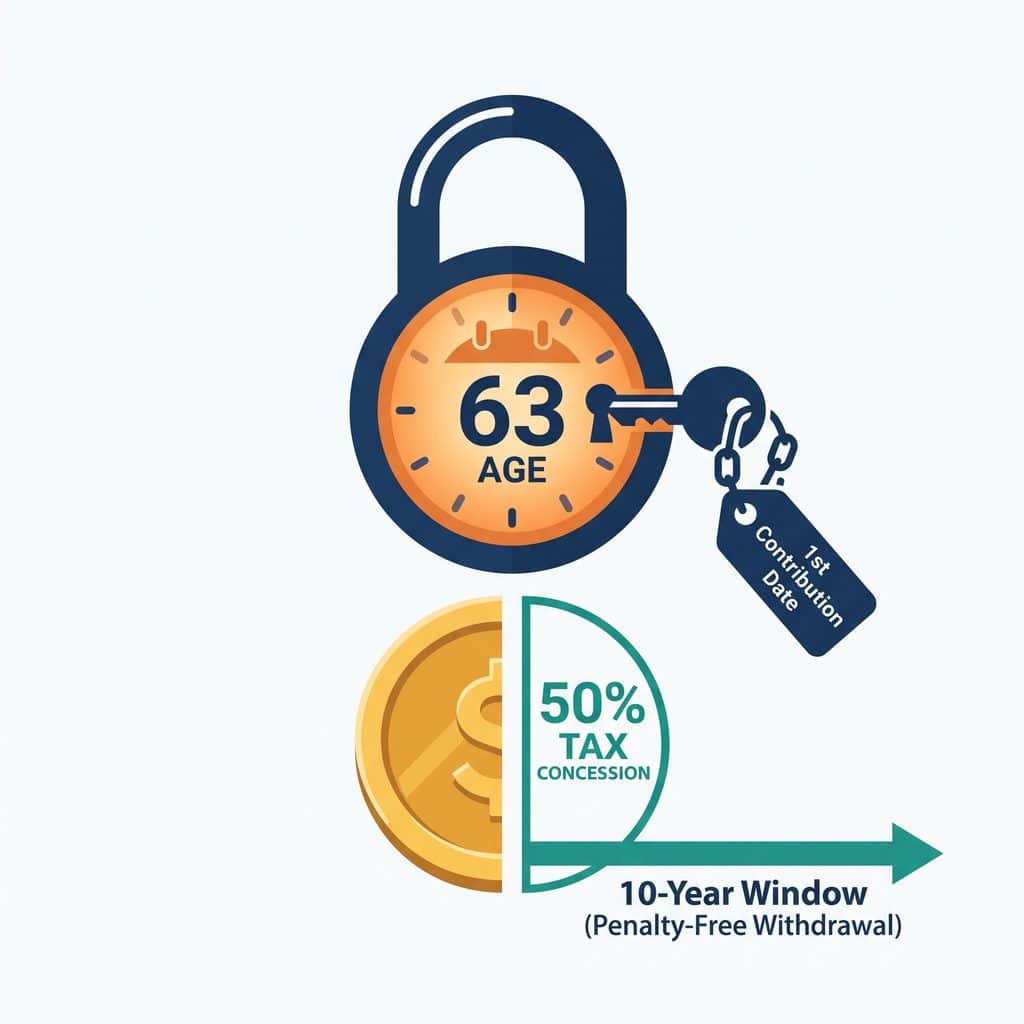
- Tax Efficiency: Singapore does not tax insurance payouts purchased with cash. However, withdrawals from annuities purchased using SRS funds face different rules. Only 50% of the withdrawal amount is subject to tax if withdrawn at or after the statutory retirement age that was prevailing at the time of your first SRS contribution, and this can be spread over a 10-year period to minimize tax liabilities. Early withdrawals attract a 5% penalty, and 100% of the withdrawn amount becomes subject to tax.
| Withdrawal Condition | Taxable Amount | Financial Penalty |
|---|---|---|
| On or after statutory retirement age | 50% of withdrawal amount | None |
| Early withdrawal (before retirement age) | 100% of withdrawal amount | 5% flat penalty |
| Medical grounds (Terminal Illness/Death) | 50% of withdrawal amount | None |
- Disability Protection: Some policies include premium waivers or increased payouts if you suffer a severe disability. Additionally, modern private annuities include built-in coverage for death, terminal illness, and additional payouts for loss of independence, which complement the CareShield Life framework.
Understanding Liquidity Risks and Surrender Penalties
Private annuities are structurally designed for long-term holding. Cashing out or surrendering a policy during the early years of the accumulation phase almost universally results in a severe financial loss, where the surrender value is significantly lower than the total premiums paid. The break-even period for most participating products typically ranges from year five to year eight, and early surrender often results in the total forfeiture of terminal bonuses. To prevent forced liquidations, always maintain emergency cash and readily accessible savings outside of the annuity structure.
Consumer Evaluation Checklist: Before signing any annuity contract, evaluate these three specific metrics:
- The Guaranteed Payout: The absolute baseline promised.
- The Payout End Date: Confirm if it covers a term or a lifetime.
- The Surrender Value: Understand the financial penalty of early exit.
Conclusion
Planning for retirement requires careful thought and the right financial tools to ensure you maintain your standard of living. For the “sandwich generation” facing the dual burden of supporting aging parents while funding their children’s education, predictable retirement income is highly desirable. A well-structured policy gives you the freedom to retire on your own terms, without relying solely on standard government age limits. You gain incredible flexibility, potential investment upside, and the peace of mind of a guaranteed income floor to enjoy your later years stress-free.
Ready to bridge your retirement gap? Fill out our contact form for a personalized comparison of Singapore’s top private annuity plans today.
"*" indicates required fields
